🎧 What to Do When You Listen to the Audio in the HSK1 Exam
-
Look at the pictures or options before the audio starts and quickly guess the topic.
-
Listen only for key words like verbs, numbers, time, people, or actions.
-
Do not try to understand every word; one important word is enough.
-
The audio is played twice, so stay calm if you miss it the first time.
-
Choose the picture or option that best matches what you hear, not what you imagine.
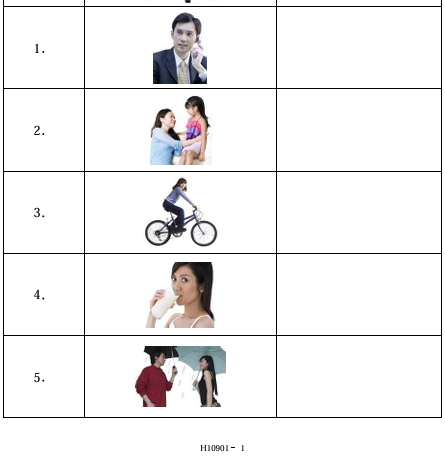
1.打电话
Pinyin: dǎ diànhuà
Meaning: to make a phone call
🔎 Identify by: phone, calling action, hand near ear
2.我和儿子
Pinyin: wǒ hé érzi
Meaning: me and my son
🔎 Identify by: two people, parent and child
3.开车
Pinyin: kāi chē
Meaning: to drive a car
🔎 Identify by: car, steering wheel, road
4.吃米饭
Pinyin: chī mǐfàn
Meaning: to eat rice
🔎 Identify by: bowl, chopsticks, rice
5.喝水
Pinyin: hē shuǐ
Meaning: to drink water
🔎 Identify by: glass, bottle, drinking action
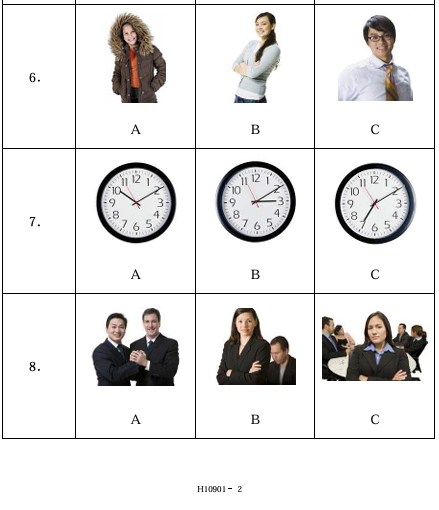
6.今天很冷
Pinyin: jīntiān hěn lěng
Meaning: today is very cold
🔎 Identify by: jacket, scarf, cold weather
7.现在是十点十分
Pinyin: xiànzài shì shí diǎn shí fēn
Meaning: now it is 10:10
🔎 Identify by: clock showing 10:10
8.她们几个人
Pinyin: tāmen jǐ gè rén
Meaning: how many people are they
🔎 Identify by: group of people, counting
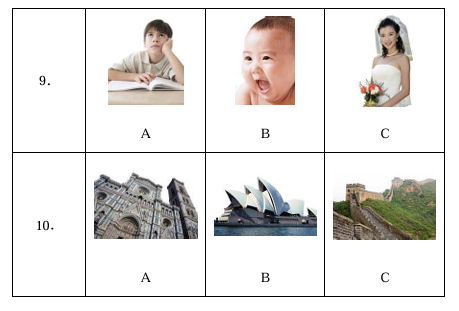
9.我今年十二岁了
Pinyin: wǒ jīnnián shí’èr suì le
Meaning: I am 12 years old this year
🔎 Identify by: child, birthday, number 12
10.他是老师
Pinyin: tā shì lǎoshī
Meaning: he is a teacher
🔎 Identify by: classroom, blackboard, teacher
🎧 HSK1 H10901 Listening – Section 2
(第二部分:对话理解)
🔹 Introduction (What this section is)
-
You will hear short dialogues (usually 2 lines: Man + Woman).
-
Each dialogue is played twice.
-
You must choose the correct picture or written option based on the dialogue.
-
The key is to understand the main idea, not every word.
✅ How to Do the Exam (Step-by-Step)
-
Read the options first (pictures or text) before the audio starts.
-
While listening, focus on key words: place, number, money, action.
-
Ignore unknown words; HSK1 answers depend on one clear clue.
-
Listen again to confirm, not to re-translate.
-
Mark the answer that directly matches the dialogue, not your guess.
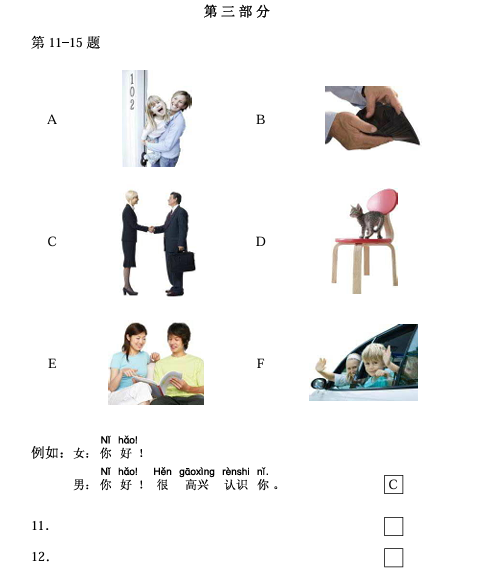
11.
男:你看见我的小猫了吗?
Nán: Nǐ kànjiàn wǒ de xiǎo māo le ma?
Man: Have you seen my kitten?
女:在那儿,在椅子。
Nǚ: Zài nàr, zài yǐzi.
Woman: There, on the chair.
🔎 Answer focus:
✔️ Picture showing a cat on a chair
12.
女:我们中午去买,好吗?
Nǚ: Wǒmen zhōngwǔ qù mǎi, hǎo ma?
Woman: Shall we go buy (something) at noon?
男:你看,我没钱了。
Nán: Nǐ kàn, wǒ méi qián le.
Man: Look, I have no money.
🔎 Answer focus:
✔️ Picture showing no money / empty wallet
13.
男:你住在哪儿?
Nán: Nǐ zhù zài nǎr?
Man: Where do you live?
女:我和妈妈都住在一零二。
Nǚ: Wǒ hé māma dōu zhù zài yī líng èr.
Woman: My mother and I both live in 102.
🔎 Answer focus:
✔️ Picture or option with Room 102
14.
女:这个汉字怎么读?
Nǚ: Zhège Hànzì zěnme dú?
Woman: How do you read this Chinese character?
男:对不起,我不会。
Nán: Duìbuqǐ, wǒ bú huì.
Man: Sorry, I don’t know.
🔎 Answer focus:
✔️ Option showing does not know / cannot read
15.
男:谢谢你们!
Nán: Xièxie nǐmen!
Man: Thank you (plural)!
女:不客气,再见。
Nǚ: Bú kèqi, zàijiàn.
Woman: You’re welcome, goodbye.
🔎 Answer focus:
✔️ Picture showing people saying goodbye
🎯 Section 2 Golden Rule
👉 Listen for the answer word, not the full sentence
🎧 HSK1 Listening – Section 3
(第三部分:听句子,回答问题)
🔹 Integrated Exam Tip (Very Important)
In HSK1, the answer options have pinyin written on top.
This means you do not need to read all Chinese characters.
While listening, match the sound you hear directly with the pinyin you see.
Focus especially on question words like shéi, shénme, shénme shíhou, duōshǎo, zěnmeyàng.
Use the second listening only to confirm the pinyin match, not to translate.
👉 Sound → Pinyin → Correct Answer
✅ How to Do Listening Section 3 Correctly
-
Listen to the full sentence once (context).
-
Listen carefully to the question (this gives the answer type).
-
Look at the pinyin above the options and match the sound.
-
Ignore extra words that are not asked in the question.
-
Mark the option that answers the question exactly.
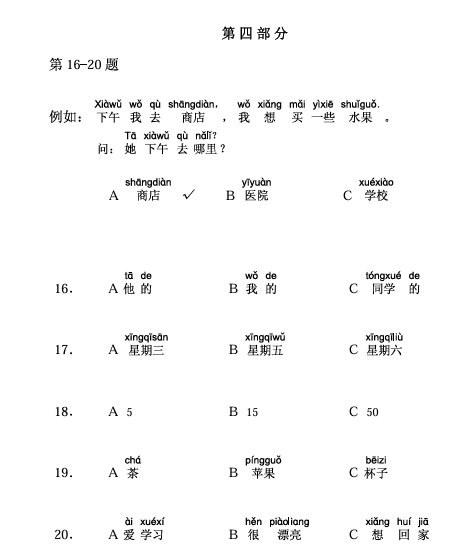
16.
🔊 Sentence
我的电脑在他的桌子上。
wǒ de diànnǎo zài tā de zhuōzi shàng
My computer is on his desk.
❓ Question
那是谁的电脑?
nà shì shéi de diànnǎo
Whose computer is that?
🔘 Options
✅ Answer: B 我 的 (wǒ de — mine)
17.
🔊 Sentence
今天星期四,我们明天去看电影。
jīntiān xīngqīsì, wǒmen míngtiān qù kàn diànyǐng
Today is Thursday. We will go watch a movie tomorrow.
❓ Question
我们什么时候去看电影?
wǒmen shénme shíhou qù kàn diànyǐng
When will we go watch a movie?
🔘 Options
✅ Answer: B 星期五 (xīngqīwǔ — Friday)
👉 Because today is Thursday, tomorrow is Friday.
18.
🔊 Sentence
他是老师,他有五十个学生。
tā shì lǎoshī, tā yǒu wǔshí gè xuéshēng
He is a teacher. He has 50 students.
❓ Question
他多少个学生?
tā duōshǎo gè xuéshēng
How many students does he have?
🔘 Options
-
A 五
wǔ — five
-
B 十五
shíwǔ — fifteen
-
C 五十
wǔshí — fifty
✅ Answer: C 五十 (wǔshí — fifty)
19.
🔊 Sentence
小姐,你好,你这儿有杯子吗?
xiǎojiě, nǐ hǎo, nǐ zhèr yǒu bēizi ma
Miss, hello, do you have cups here?
❓ Question
他想买什么?
tā xiǎng mǎi shénme
What does he want to buy?
🔘 Options
-
A 茶
chá — tea
-
B 苹果
píngguǒ — apple
-
C 杯子
bēizi — cup
✅ Answer: C 杯子 (bēizi — cup)
20.
🔊 Sentence
这是你的朋友吗?很漂亮。
zhè shì nǐ de péngyou ma? hěn piàoliang
Is this your friend? Very beautiful.
❓ Question
朋友怎么样?
péngyou zěnmeyàng
How is the friend?
🔘 Options
-
A 爱学习
ài xuéxí — loves studying
-
B 很漂亮
hěn piàoliang — very beautiful
-
C 想回家
xiǎng huí jiā — wants to go home
✅ Answer: B 很漂亮 (hěn piàoliang — very beautiful)
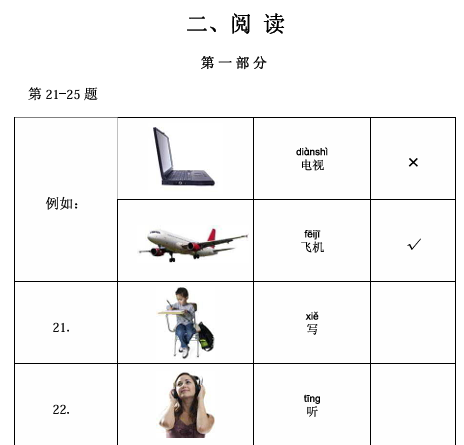
阅读 (Reading)
第一部分(21–25 题)
📌 Reading Exam Tip (Very Important – Like Listening)
In HSK1 Reading Section 1, you will see pictures + one word.
Your task is to decide whether the word matches the picture.
If the picture and the word match, mark ✓ (right).
If they do not match, mark ✗ (wrong).
Do not overthink — this section tests basic vocabulary recognition only.
👉 Picture → Meaning → Decide ✓ or ✗
📝 Questions 21–25 (With Answers)
21.
🖼️ Picture
👉 A boy writing
🈶 Word
写
✅ Answer: ✓ Right
✔️ Picture matches 写 (to write)
22.
🖼️ Picture
👉 A girl listening to music with headphones
🈶 Word
听
✅ Answer: ✓ Right
✔️ Picture matches 听 (to listen)
23.
🖼️ Picture
👉 A cup of soup / drink
🈶 Word
菜
❌ Answer: ✗ Wrong
❌ Picture shows drink/soup, not 菜 (dish/food)
24.
🖼️ Picture
👉 A woman
🈶 Word
他
❌ Answer: ✗ Wrong
❌ Picture is female, but 他 = he (male)
25.
🖼️ Picture
👉 A dog
🈶 Word
狗
✅ Answer: ✓ Right
✔️ Picture matches 狗 (dog)
🎯 Final Golden Rule for HSK1 Reading Section
👉 If you know the word, you can answer in 2 seconds.
👉 If picture ≠ meaning → ✗
👉 If picture = meaning → ✓
Reading Exam Tip (Very Important)
In HSK1 Reading Section 2, you read one simple sentence.
You must choose the picture (A–F) that best matches the sentence.
Do not translate every word — just match meaning with picture.
Most answers depend on one key verb or object.
Choose only ONE correct picture.
👉 Sentence → Key word → Picture
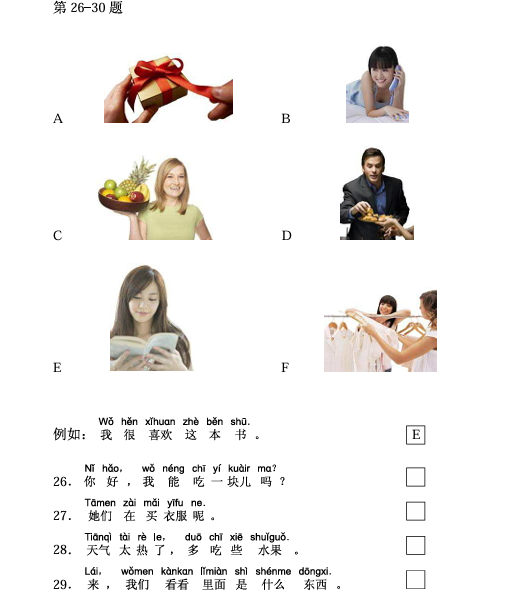
26.
📘 Sentence
你好,我能吃一块吗?
Meaning: Hello, can I eat one piece?
🖼️ Picture Match
👉 Someone offering / taking food
✅ Answer: D
(D = a man taking food)
27.
📘 Sentence
她们在买衣服呢。
Meaning: They are buying clothes.
🖼️ Picture Match
👉 People shopping for clothes
✅ Answer: F
(F = people choosing clothes on hangers)
28.
📘 Sentence
天气太热了,多吃些水果。
Meaning: The weather is too hot, eat more fruit.
🖼️ Picture Match
👉 Fruit
✅ Answer: C
(C = woman holding a bowl of fruit)
29.
📘 Sentence
来,我们看看里面是什么东西。
Meaning: Come, let’s see what is inside.
🖼️ Picture Match
👉 Opening / looking inside a box
✅ Answer: A
(A = opening a gift box)
30.
📘 Sentence
喂,你睡觉了吗?
Meaning: Hey, are you asleep?
🖼️ Picture Match
👉 Person lying down / resting / on phone
✅ Answer: B
(B = girl lying down, talking on phone)
🎯 Final Golden Rule – Reading Section 2
👉 Focus on verbs like:
-
吃 (chī – eat)
-
买 (mǎi – buy)
-
看 (kàn – look)
-
睡觉 (shuìjiào – sleep)
👉 One key word = correct picture
第三部分(31–35 题)
Reading Exam Tip (Very Important)
In HSK1 Reading Section 3, you must match a question with the correct answer.
First, look at the question word (谁 / 多大 / 在哪儿 / 怎么样 / 什么时候).
Then find the option that logically answers that question.
Do not match words randomly — match question type + meaning.
Only one option is correct.
👉 Question word → Meaning → Correct answer
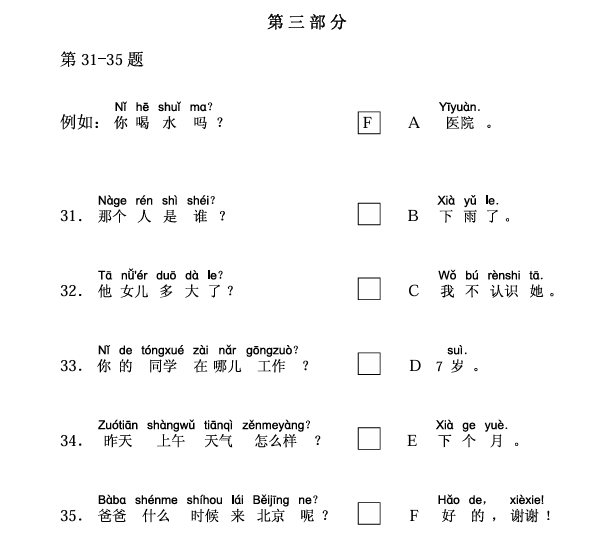
Reading Exam Tip (Very Important)
In HSK1 Reading Section 3, you must match a question with the correct answer.
First, look at the question word (谁 / 多大 / 在哪儿 / 怎么样 / 什么时候).
Then find the option that logically answers that question.
Do not match words randomly — match question type + meaning.
Only one option is correct.
👉 Question word → Meaning → Correct answer
📖 Example(例 如)
你喝水吗?
Answer:
F 好的,谢谢!
-
hǎo de, xièxie
-
okay | (polite) | thanks
✅ Correct because it is a natural reply.
📝 Questions 31–35 (With Answers)
31.
❓ Question
那个人是谁?
Meaning: Who is that person?
🔘 Options
-
A 医院
yīyuàn — hospital
-
B 下雨了
xià yǔ le — it’s raining
-
C 我不认识她
wǒ bù rènshi tā — I don’t know her
-
D 7 岁
qī suì — 7 years old
-
E 下个月
xià gè yuè — next month
-
F 好的,谢谢
hǎo de, xièxie — okay, thank you
✅ Answer: C 我不认识她
(I don’t know her → answers “who”)
32.
❓ Question
他女儿多大了?
Meaning: How old is his daughter?
🔘 Options
✅ Answer: D 7 岁
(7 years old → answers age)
33.
❓ Question
你的同学在哪儿工作?
Meaning: Where does your classmate work?
🔘 Options
✅ Answer: A 医院
(Hospital → place of work)
34.
❓ Question
昨天上午天气怎么样?
Meaning: How was the weather yesterday morning?
🔘 Options
✅ Answer: B 下雨了
(It rained → describes weather)
35.
❓ Question
爸爸什么时候来北京呢?
Meaning: When will dad come to Beijing?
🔘 Options
✅ Answer: E 下个月
(Next month → answers “when”)
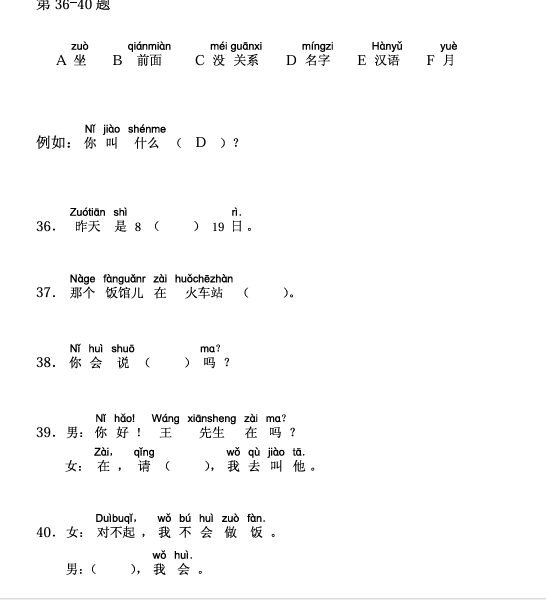
36
昨天是8( )19日。
Zuótiān shì 8 ( ) 19 rì.
Yesterday was 8 ( ) 19th.
✅ Answer: F 月 (yuè) – month
Zuótiān shì 8 yuè 19 rì.
Yesterday was August 19th.
37
那个饭馆儿在火车站( )。
Nàge fànguǎnr zài huǒchēzhàn ( ).
That restaurant is at the train station ( ).
-
Options:
-
A 坐 (zuò) – sit
-
B 前面 (qiánmiàn) – in front
-
C 没关系 (méi guānxi) – doesn’t matter
-
D 名字 (míngzi) – name
-
E 汉语 (Hànyǔ) – Chinese language
-
F 月 (yuè) – month
✅ Answer: B 前面 (qiánmiàn) – in front
Nàge fànguǎnr zài huǒchēzhàn qiánmiàn.
That restaurant is in front of the train station.
38
你会说( )吗?
Nǐ huì shuō ( ) ma?
Can you speak ( )?
✅ Answer: E 汉语 (Hànyǔ) – Chinese language
Nǐ huì shuō Hànyǔ ma?
Can you speak Chinese?
Want to watch in Youtube: H10901
https://youtu.be/qTeZJEuo8Zo